An intellectual is a person who engages in critical thinking, research, and reflection about the reality of society, who may also propose solutions for the normative problems of society, and thus gains authority as a public intellectual.[2][3] Coming from the world of culture, either as a creator or as a mediator, the intellectual participates in politics, either to defend a concrete proposition or to denounce an injustice, usually by either rejecting or producing or extending an ideology, and by defending a system of values.[4] According to Thomas Sowell, as a descriptive term of person, personality, and profession, the word intellectual identifies three traits:
- Educated; erudition for developing theories;
- Productive; creates cultural capital in the fields of philosophy, literary criticism, and sociology, law, medicine, and science, etc.; and
- Artistic; creates art in literature, music, painting, sculpture, etc.[5][page needed]

Historical definitions
In Latin language, at least starting from the Carolingian Empire, intellectuals could be called litterati, a term which is sometimes applied today.
Socially, intellectuals constitute the intelligentsia, a status class organised either by ideology (conservative, fascist, socialist, liberal, reactionary, revolutionary, democratic, communist intellectuals, et al.), or by nationality (American intellectuals, French intellectuals, Ibero–American intellectuals, et al.). The contemporary intellectual class originated from the intelligentsiya of Tsarist Russia (c. 1860s–1870s), the social stratum of those possessing intellectual formation (schooling, education, Enlightenment), and who were Russian society's counterpart to the German Bildungsbürgertum and to the French bourgeoisie éclairée, the enlightened middle classes of those realms.[6][a]
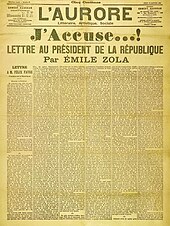
The term Intellectual was coined in the late 19th century, amidst the Dreyfus affair (1894–1906), an identity crisis of anti-semitic nationalism for the French Third Republic (1870–1940), the reactionary anti–Dreyfusards (Maurice Barrès, Ferdinand Brunetière, et al.) used the terms intellectual and the intellectuals to deride the liberal Dreyfusards (Émile Zola, Octave Mirbeau, Anatole France, et al.) as political dilettantes from the realms of French culture, art, and science, who had become involved in politics, by publicly advocating for the exoneration and liberation of Alfred Dreyfus, a Jewish French artillery captain falsely accused of betraying France to Germany.[7]
In the 20th century, the term intellectual acquired positive connotations of social prestige, derived from possessing intellect and intelligence, especially when the intellectual's activities exerted positive consequences in the public sphere and so increased the intellectual understanding of the public, by means of moral responsibility, altruism, and solidarity, without resorting to the manipulations of demagoguery, paternalism and incivility (condescension).[6][b] Hence, for the educated person of a society, participating in the public sphere—the political affairs of the city-state—is a civic responsibility dating from the Græco–Latin Classical era:
The determining factor for a Thinker (historian, philosopher, scientist, writer, artist, et al.) to be considered a public intellectual is the degree to which he or she is implicated and engaged with the vital reality of the contemporary world; that is to say, participation in the public affairs of society. Consequently, being designated as a public intellectual is determined by the degree of influence of the designator's motivations, opinions, and options of action (social, political, ideological), and by affinity with the given thinker; therefore:[c]
Analogously, the application and the conceptual value of the terms intellectual and the intellectuals are socially negative when the practice of intellectuality is exclusively in service to the Establishment who wield power in a society, as such:
Chomsky's negative view of the Establishment Intellectual suggests the existence of another kind of intellectual one might call "the public intellectual" which is the following:
"Man of letters"
The term "man of letters" derives from the French term belletrist or homme de lettres but is not synonymous with "an academic".[15][16] A "man of letters" was a literate man, able to read and write, as opposed to an illiterate man in a time when literacy was rare and thus highly valued in the upper strata of society. In the 17th and 18th centuries, the term Belletrist(s) came to be applied to the literati: the French participants in—sometimes referred to as "citizens" of—the Republic of Letters, which evolved into the salon, a social institution, usually run by a hostess, meant for the edification, education, and cultural refinement of the participants.
Historical background
In English, the term intellectual identifies a "literate thinker"; its earlier usage, as in the book title The Evolution of an Intellectual (1920), by John Middleton Murry, denotes literary activity, rather than the activities of the public intellectual.[17]
19th-century
Britain
In the late 19th century, when literacy was relatively common in European countries such as the United Kingdom, the "Man of Letters" (littérateur)[18] denotation broadened to mean "specialized", a man who earned his living writing intellectually (not creatively) about literature: the essayist, the journalist, the critic, et al. In the 20th century, such an approach was gradually superseded by the academic method, and the term "Man of Letters" became disused, replaced by the generic term "intellectual", describing the intellectual person. In late 19th century, the term intellectual became common usage to denote the defenders of the falsely accused artillery officer Alfred Dreyfus.[19]
Continental Europe
In early 19th century Britain, Samuel Taylor Coleridge coined the term clerisy, the intellectual class responsible for upholding and maintaining the national culture, the secular equivalent of the Anglican clergy. Likewise, in Tsarist Russia, there arose the intelligentsia (1860s–70s), who were the status class of white-collar workers. The theologian Alister McGrath said that "the emergence of a socially alienated, theologically literate, antiestablishment lay intelligentsia is one of the more significant phenomena of the social history of Germany in the 1830s", and that "three or four theological graduates in ten might hope to find employment" in a church post.[20] As such, politically radical thinkers already had participated in the French Revolution (1789–1799); Robert Darnton said that they were not societal outsiders, but "respectable, domesticated, and assimilated".[21]
Thenceforth, an intellectual class in Europe was socially important, especially to self-styled intellectuals, whose participation in society's arts, politics, journalism, and education—of either nationalist, internationalist, or ethnic sentiment—constitute "vocation of the intellectual". Moreover, some intellectuals were anti-academic, despite universities (the Academy) being synonymous with intellectualism.
In France, the Dreyfus affair marked the full emergence of the "intellectual in public life", especially Émile Zola, Octave Mirbeau and Anatole France directly addressing the matter of French antisemitism to the public; thenceforward, "intellectual" became common, yet occasionally derogatory, usage; its French noun usage is attributed to Georges Clemenceau in 1898.
Germany
Jürgen Habermas' Structural Transformation of Public Sphere (1963) made significant contribution to the notion of public intellectual by historically and conceptually delineating the idea of private and public. Controversial, in the same year, was Ralf Dahrendorf's definition: “As the court-jesters of modern society, all intellectuals have the duty to doubt everything that is obvious, to make relative all authority, to ask all those questions that no one else dares to ask".[22]
In the East
The word intellectual is found in Indian scripture Mahabharata in the Bachelorette meeting (Swayambara Sava) of Draupadi. Immediately after Arjuna and Raja-Maharaja (kings-emperors) came to the meeting, Nipuna Buddhijibina (perfect intellectuals) appeared at the meeting. These people were then busy in argument about whether anyone can shoot the target or not.[23]
In Imperial China in the period from 206 BC until AD 1912, the intellectuals were the Scholar-officials ("Scholar-gentlemen"), who were civil servants appointed by the Emperor of China to perform the tasks of daily governance. Such civil servants earned academic degrees by means of imperial examination, and also were skilled calligraphers, and knew Confucian philosophy. Historian Wing-Tsit Chan concludes that:
In Joseon Korea (1392–1910), the intellectuals were the literati, who knew how to read and write, and had been designated, as the chungin (the "middle people"), in accordance with the Confucian system. Socially, they constituted the petite bourgeoisie, composed of scholar-bureaucrats (scholars, professionals, and technicians) who administered the dynastic rule of the Joseon dynasty.[25]
Intelligentsia
Addressing their role as a social class, Jean-Paul Sartre said that intellectuals are the moral conscience of their age; that their moral and ethical responsibilities are to observe the socio-political moment, and to freely speak to their society, in accordance with their consciences.[26] Like Sartre and Noam Chomsky, public intellectuals usually are polymaths, knowledgeable of the international order of the world, the political and economic organization of contemporary society, the institutions and laws that regulate the lives of the layman citizen, the educational systems, and the private networks of mass communication media that control the broadcasting of information to the public.[27]
Whereas, intellectuals (political scientists and sociologists), liberals, and democratic socialists usually hold, advocate, and support the principles of democracy (liberty, equality, fraternity, human rights, social justice, social welfare, environmental conservation), and the improvement of socio-political relations in domestic and international politics, the conservative public-intellectuals usually defend the social, economic, and political status quo as the realisation of the "perfect ideals" of Platonism, and present a static dominant ideology, in which utopias are unattainable and politically destabilizing of society.
Public intellectual

The term public intellectual describes the intellectual participating in the public-affairs discourse of society, in addition to an academic career.[28] Regardless of the academic field or the professional expertise, the public intellectual addresses and responds to the normative problems of society, and, as such, is expected to be an impartial critic who can "rise above the partial preoccupation of one's own profession—and engage with the global issues of truth, judgment, and taste of the time".[29][30] In Representations of the Intellectual (1994), Edward Saïd said that the "true intellectual is, therefore, always an outsider, living in self-imposed exile, and on the margins of society".[31]
An intellectual usually is associated with an ideology or with a philosophy, e.g. the Third Way centrism of Anthony Giddens in the Labour Government of Tony Blair.[32] The Czech intellectual Václav Havel said that politics and intellectuals can be linked, but that moral responsibility for the intellectual's ideas, even when advocated by a politician, remains with the intellectual. Therefore, it is best to avoid utopian intellectuals who offer 'universal insights' to resolve the problems of political economy with public policies that might harm and that have harmed civil society; that intellectuals be mindful of the social and cultural ties created with their words, insights and ideas; and should be heard as social critics of politics and power.[33][34]
Social background
The American academic Peter H. Smith describes the intellectuals of Latin America as people from an identifiable social class, who have been conditioned by that common experience and thus are inclined to share a set of common assumptions (values and ethics); that ninety-four per cent of intellectuals come either from the middle class or from the upper class and that only six per cent come from the working class. Philosopher Steven Fuller said that because cultural capital confers power and social status as a status group they must be autonomous in order to be credible as intellectuals:
The political importance and effective consequence of Émile Zola in the Dreyfus affair (1894–1906) derived from his being a leading French thinker; thus, J'accuse (I Accuse), his open letter to the French government and the nation proved critical to achieving the exoneration of Captain Alfred Dreyfus of the false charges of treason, which were facilitated by institutional anti-Semitism, among other ideological defects of the French Establishment.
Academic background
In journalism, the term intellectual usually connotes "a university academic" of the humanities—especially a philosopher—who addresses important social and political matters of the day. Hence, such an academic functions as a public intellectual who explains the theoretic bases of said problems and communicates possible answers to the policy makers and executive leaders of society. The sociologist Frank Furedi said that "Intellectuals are not defined according to the jobs they do, but [by] the manner in which they act, the way they see themselves, and the [social and political] values that they uphold.[36] Public intellectuals usually arise from the educated élite of a society; although the North American usage of the term "intellectual" includes the university academics.[37] The difference between "intellectual" and "academic" is participation in the realm of public affairs.[38]
Public policy role
In the matters of public policy, the public intellectual connects scholarly research to the practical matters of solving societal problems. The British sociologist Michael Burawoy, an exponent of public sociology, said that professional sociology has failed, by giving insufficient attention to resolving social problems, and that a dialogue between the academic and the layman would bridge the gap.[39] An example is how Chilean intellectuals worked to reestablish democracy within the right-wing, neoliberal governments of the Military dictatorship of Chile (1973–90), the Pinochet régime allowed professional opportunities for some liberal and left-wing social scientists to work as politicians and as consultants in effort to realize the theoretical economics of the Chicago Boys, but their access to power was contingent upon political pragmatism, abandoning the political neutrality of the academic intellectual.[40]
In The Sociological Imagination (1959), C. Wright Mills said that academics had become ill-equipped for participating in public discourse, and that journalists usually are "more politically alert and knowledgeable than sociologists, economists, and especially ... political scientists".[41] That, because the universities of the U.S. are bureaucratic, private businesses, they "do not teach critical reasoning to the student", who then does not "how to gauge what is going on in the general struggle for power in modern society".[41] Likewise, Richard Rorty criticized the participation of intellectuals in public discourse as an example of the "civic irresponsibility of intellect, especially academic intellect".[42]
The American legal scholar Richard Posner said that the participation of academic public intellectuals in the public life of society is characterized by logically untidy and politically biased statements of the kind that would be unacceptable to academia. That there are few ideologically and politically independent public intellectuals, and disapproves that public intellectuals limit themselves to practical matters of public policy, and not with values or public philosophy, or public ethics, or public theology, not with matters of moral and spiritual outrage.
Persecution of intellectuals
Totalitarian governments manipulate and apply anti-intellectualism to repress political dissent. During the Spanish Civil War (1936–1939) and the following dictatorship (1939–1975) of General Francisco Franco, the reactionary repression of the White Terror (1936–1945) was notably anti-intellectual, with most of the 200,000 civilians killed being the Spanish intelligentsia, the politically active teachers and academics, artists and writers of the deposed Second Spanish Republic (1931–1939). Intellectuals were also targeted by the Nazis, the Communist regime in China, the Khmer Rouge, the Young Turks, and in conflicts in Bangladesh, the former Yugoslavia, Poland,.
Criticism
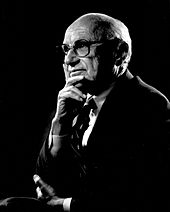
In "An Interview with Milton Friedman" (1974), the American economist Milton Friedman said that businessmen and the intellectuals are enemies of capitalism. The intellectuals because most believed in socialism while the businessman expected economic privileges:
In "The Intellectuals and Socialism" (1949), the British economist Friedrich Hayek said that "journalists, teachers, ministers, lecturers, publicists, radio commentators, writers of fiction, cartoonists, and artists" are the intellectual social class whose function is to communicate the complex and specialized knowledge of the scientist to the general public. That in the 20th century, the intellectuals were attracted to socialism and to social democracy because the socialists offered "broad visions; the spacious comprehension of the social order, as a whole, which a planned system promises" and that such broad-vision philosophies "succeeded in inspiring the imagination of the intellectuals" to change and improve their societies.[44]
According to Hayek, intellectuals disproportionately support socialism for idealistic and utopian reasons that cannot be realized in practical terms.[45] Nonetheless, Albert Einstein said in the article "Why Socialism?" (1949), that the economy of the world is not private property because it is a "planetary community of production and consumption".[46] In American society, the intellectual status class are demographically characterized as people who hold liberal-to-leftist political perspectives about guns-or-butter fiscal policy.[47]

In "The Heartless Lovers of Humankind" (1987), the journalist and popular historian Paul Johnson said:
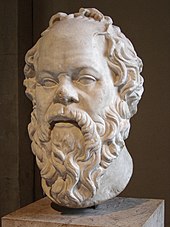
The public- and private-knowledge dichotomy originated in Ancient Greece, from Socrates's rejection of the Sophist concept that the pursuit of knowledge (truth) is a "public market of ideas", open to all men of the city, not only to philosophers. In contradiction to the Sophist's public market of knowledge, Socrates proposed a knowledge monopoly for and by the philosophers. Thus, "those who sought a more penetrating and rigorous intellectual life rejected, and withdrew from, the general culture of the city, in order to embrace a new model of professionalism", namely the private market of ideas.[49]

Addressing the societal place, roles and functions of intellectuals in 19th century American society, the Congregational theologian Edwards Amasa Park said: "We do wrong to our own minds, when we carry out scientific difficulties down to the arena of popular dissension".[49] That for the stability of society (social, economic and political) it is necessary "to separate the serious, technical role of professionals from their responsibility [for] supplying usable philosophies for the general public". Thus, operated Socrate's cultural dichotomy of public-knowledge and private-knowledge, of "civic culture" and "professional culture", the social constructs that describe and establish the intellectual sphere of life as separate and apart from the civic sphere of life.[49][50]
British philosopher Bertrand Russell once said, "I have never called myself an intellectual, and no one has dared to call me one in my presence. I think an intellectual may be defined as a person who pretends to have more intellect than he has, and I hope this definition does not fit me."[51]
Richard Hofstadter quipped that, "an intellectual is a person who likes to turn easy answers into harder questions."[51]
Intelligentsia
The American historian Norman Stone said that the intellectual social class misunderstand the reality of society and so are doomed to the errors of logical fallacy, ideological stupidity, and poor planning hampered by ideology.[52] In her memoirs, the Conservative politician Margaret Thatcher said that the anti-monarchical French Revolution (1789–1799) was "a utopian attempt to overthrow a traditional order [...] in the name of abstract ideas, formulated by vain intellectuals".[53] Yet, as Prime Minister she asked Britain's academics to help her government resolve the social problems of British society—whilst she retained the populist opinion of "The Intellectual" as being a man of un-British character, a thinker, not a doer. Thatcher's anti-intellectualist perspective was shared by the mass media, especially The Spectator and The Sunday Telegraph newspapers, whose reportage documented a "lack of intellectuals" in Britain.[33][54]
In his essay "Why do intellectuals oppose capitalism?" (1998), the American libertarian philosopher Robert Nozick of the Cato Institute argued that intellectuals become embittered leftists because their academic skills, much rewarded at school and at university, are undervalued and underpaid in the capitalist market economy. Thus, the intellectuals turned against capitalism—despite enjoying a more economically and financially comfortable life in a capitalist society than they might enjoy in either socialism or communism.[55]
In post-communist Europe, the social attitude perception of the intelligentsia became anti-intellectual. In the Netherlands, the word intellectual negatively connotes an overeducated person of "unrealistic visions of the World". In Hungary, the intellectual is perceived as an "egghead", a person who is "too-clever" for the good of society. In the Czech Republic, the intellectual is a cerebral person, aloof from reality. Such derogatory connotations of intellectual are not definitive because in the "case of English usage, positive, neutral, and pejorative uses can easily coexist". The example is Václav Havel, who "to many outside observers, [became] a favoured instance of The Intellectual as National Icon" in the early history of the post-Communist Czech Republic.[56]
In his book Intellectuals and Society (2010), the economist Thomas Sowell said that lacking disincentives in professional life, the intellectual (producer of knowledge, not material goods) tends to speak outside his or her area of expertise and expects social and professional benefits from the halo effect, derived from possessing professional expertise. That in relation to other professions, the public intellectual is socially detached from the negative and unintended consequences of public policy derived from his or her ideas. As such, the philosopher and mathematician Bertrand Russell (1872–1970) advised the British government against national rearmament in the years before World War I (1914–1918) while the German Empire prepared for war. Yet, the post-war intellectual reputation of Russell remained almost immaculate and his opinions respected by the general public because of the halo effect.[57]
| This article uses material from the Wikipedia article Metasyntactic variable, which is released under the Creative Commons Attribution-ShareAlike 3.0 Unported License. |